
Compare Supply Chain Software
This supply chain software comparison hub helps you evaluate leading platforms, understand integration requirements, and compare software costs before you buy.

Latest Supply Chain Software Comparison Guides
Vendor-neutral architectural deep dives, TCO breakdowns, and integration audits from our research desk.
 Warehouse Management Systems: 2026 Architect's Guide
2026 Warehouse Automation Systems & Robots: Ultimate TCO
Welcome to our Top 2026 guide on warehouse automation. The promise of deploying robots is straightforward: increase throughput, reduce labor costs, and…
 Warehouse Management Systems: 2026 Architect's Guide
The WMS Business Case That Survives CFO Scrutiny
A 40-page deck, a beautiful warehouse diagram, three case studies from competitors, a slide showing the current system is 12 years old,…
 ERP and Inventory Financials: 2026 Enterprise Guide
Automating Inventory-to-GL Reconciliation: The 2026 ERP Control Blueprint
Three forces drive that threshold:
 ERP and Inventory Financials: 2026 Enterprise Guide
Supply Chain & Logistics Research Firms Compared (2026 Guide)
Definition: Supply Chain Market Intelligence Desks Specialist supply chain research firms provide market benchmarking, total cost of ownership (TCO) modeling, vendor roadmaps,…
 Warehouse Management Systems: 2026 Architect's Guide
RaaS vs Capital Purchase: Warehouse Robotics TCO 2026
Definition: RaaS vs Capital Purchase This comparison evaluates two commercial structures for warehouse robotics. Under the subscription model, the operator leases robotic…
 Order Management Systems: 2026 Enterprise Guide
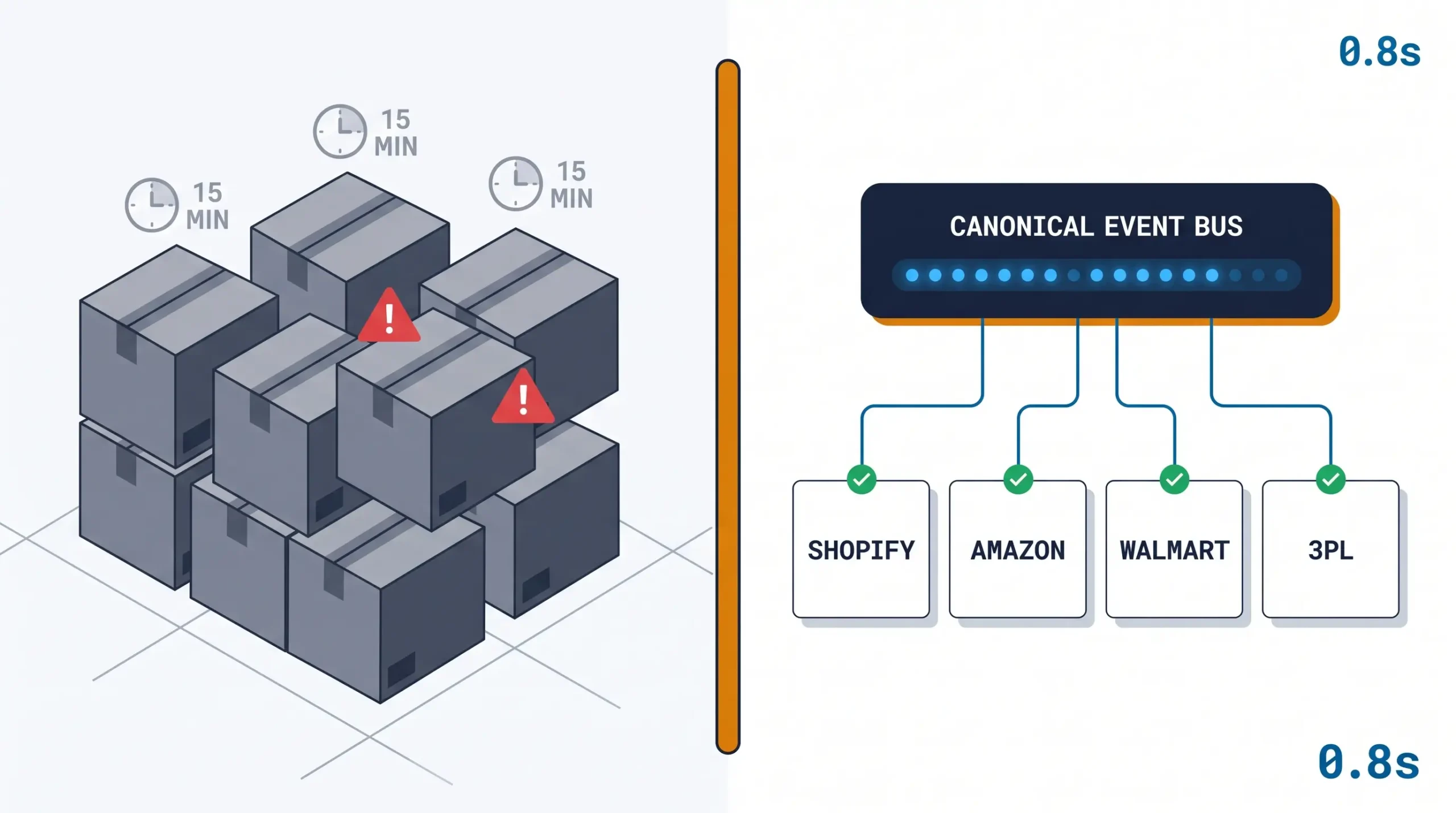
Event Driven Inventory Synchronization for Omnichannel Retailers
Event driven inventory synchronization replaces batch polling with a canonical event bus. This technical guide covers Kafka producers, idempotent consumers, dead-letter queues,…
The Market Is Flooded With Vendor Sales Pitches
Feature checklists are worthless if they do not fit your warehouse topology, peak order velocity, or legacy database schema. OrderPilots dissects enterprise logistics systems from the data layer up—helping technical buyers identify throughput bottlenecks and licensing traps before signing multi-year contracts.
Core Systems: Architecture & Lifecycle Boundaries
Technical evaluation frameworks covering each functional tier of modern fulfillment operations.
 OMS
Orchestrate Omnichannel Operations
Move beyond basic order capture. Deep-dive enterprise OMS evaluations covering real-time ATP inventory, distributed order routing, and split-shipment logic.
 WMS
Optimize Physical Fulfillment at Scale
Whether managing a multi-facility 3PL or automated distribution centers, our WMS benchmarks evaluate wave planning, slotting algorithms, and WES/MHE integration.
 ERP
Unify Financial Ledgers & Supply Chains
The ERP serves as the financial system of record. We examine SAP, Oracle, Microsoft Dynamics, and mid-market platforms to keep your execution tier cleanly decoupled.
Supply Chain Software Comparison Matrix: ERP vs OMS vs WMS
How modern cloud stacks divide system-of-record ownership and operational control to prevent costly integration rebuilds.
| Platform Tier | Source of Truth | Core Operational Focus | Critical API Bottlenecks |
|---|---|---|---|
|
OMS Tier
Order Management
Omnichannel Orchestration Layer
|
Global Order State & ATP |
|
API rate limits during flash-sale surges & webhook queue latency
|
|
WMS Tier
Warehouse Management
Physical Four-Wall Execution
|
Facility Inventory & Bins |
|
Batch sync delays with legacy ERPs & lot/serialization mismatch
|
|
ERP Tier
Enterprise Resource Planning
Financial & Procurement Core
|
General Ledger & POs |
|
Overnight monolithic batch locks & brittle point-to-point schemas
|
Platform Snapshot by Category
Representative platforms from our 24-system evaluation dataset. Full licensing, scale, and API breakdowns live inside each category hub.
| Category | Platforms Covered | Best Fit Profile | Procurement Watch-Out |
|---|---|---|---|
|
OMS Hub
Enterprise OMS
Distributed Order Routing
|
NetSuite OMS
SAP S/4HANA OM
IBM Sterling
Kibo Commerce
|
Multi-channel retailers & B2B brands with complex node routing, store-fulfillment, and split-order logic. |
Webhook throughput ceilings during peak drops & per-order-line overage tiers
|
|
WMS Hub
Warehouse Management
High-Velocity DC Execution
|
Manhattan Active WM
Blue Yonder
ShipHero
Fishbowl
|
Multi-facility 3PLs and automated distribution centers running AS/RS, AMRs, or high-density wave picking. |
Unbundled WES/MHE integration fees & per-facility / RF-seat licensing traps
|
|
ERP Hub
ERP & Financials
System of Record & Costing
|
SAP S/4HANA
Oracle Fusion
Dynamics 365
Odoo
Katana
|
Operations requiring a single financial system of record for multi-entity accounting, BOMs, and automated GL reconciliation. |
Monolithic batch cycles, SI change-order bloat & brittle custom schemas
|
The Enterprise Logistics Stack Blueprint
Eliminate conflicting vendor sales presentations. Our centralized architectural reference consolidates multi-system integration research into one execution-ready guide.
- Reference Architecture Diagrams: Clear data flow specs showing how platforms coordinate in an event-driven network.
- Multi-Vendor Evaluation Matrices: Side-by-side technical breakdowns across 24 platforms covering licensing models and scale constraints.
- Implementation Playbooks: Prevent critical synchronization bottlenecks between disparate inventory applications.
Integrating Your Core Fulfillment Infrastructure
Establishing low-latency system communication is where enterprise supply chains succeed or fail. Without structured API integration, high-growth brands face inventory reconciliation errors, inflated carrying costs, and fulfillment delays.
Performing a rigorous architectural evaluation enables engineering teams to uncover rate limits and payload constraints before building custom connectors. Resilient stacks rely on event-driven webhooks and API-first pipelines to sync order states, optimize multi-node fulfillment routing, and post financial settlements back to the general ledger without manual patching.
Most enterprise stacks settle on one of three patterns: point-to-point APIs for tightly coupled systems, an iPaaS middleware layer (MuleSoft, Boomi, Workato) for multi-vendor orchestration, or a hybrid EDI + API model where EDI remains the standard with retail trading partners while REST/GraphQL APIs handle internal state synchronization. Choosing the wrong pattern early is the most expensive mistake we see in post-implementation audits.
Supply Chain Software Comparison FAQ
Key architectural and procurement questions from operations leaders evaluating fulfillment systems in 2026.
What is the difference between an ERP, OMS, and WMS?
An ERP is the financial system of record — general ledger, procurement, COGS, billing. An OMS owns global order state and available-to-promise (ATP) across sales channels. A WMS owns physical facility inventory and bin locations, executing wave planning, directed picking, cartonization, and MHE automation. Modern stacks run all three, connected via APIs or an event bus.
Can one platform replace my ERP, OMS, and WMS?
Rarely without operational trade-offs. Suite vendors (SAP, Oracle, Microsoft) offer modules across all three tiers, but their warehouse execution and order routing depth is often thinner than best-of-breed specialists. Single-suite deployments reduce integration surface at the cost of floor-level flexibility. Most high-volume operations run a composable hybrid stack.
How should I sequence an ERP, OMS, and WMS implementation?
Start with the tier that owns your most painful operational constraint. High-growth brands usually deploy WMS first to stabilize physical fulfillment, then OMS, then ERP. Enterprises with legacy ERPs often migrate the ERP last, using an API middleware layer to buffer the transition. Never cut over all three simultaneously.
What are the biggest API integration risks in supply chain stacks?
Rate limits that throttle order ingestion during peak flash sales, webhook latency that causes stale inventory visibility (overselling), and schema drift between legacy batch systems and modern API-first platforms. All three are preventable with load testing, idempotent event handling, and a versioned integration contract.
How does OrderPilots evaluate these platforms independently?
Every supply chain software comparison and architectural audit on OrderPilots is built from primary engineering and financial sources: public vendor API documentation, developer schemas, verified licensing structures, and public SEC filings. We do not accept vendor sponsorships or paid placement fees.
Independent Research Grounded in Primary Technical Sources
Our evaluation methodology:
Every supply chain software comparison and architectural audit on OrderPilots is built from primary sources: published vendor API documentation, integration specs, verified licensing models, and public financial filings. We operate independently and do not accept vendor advertising, sponsorships, or paid placement fees.